Best Solid Wood Daybed for Kids in a Shared Room
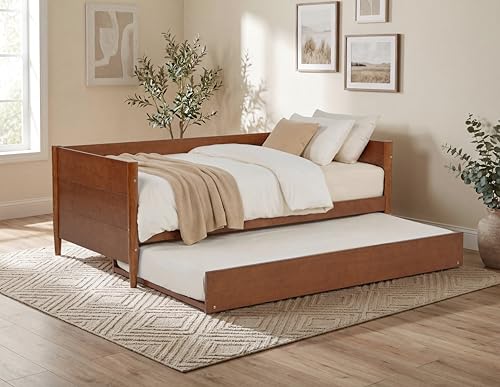
Six twin and full daybeds compared on slat count, stated weight capacity, guard rails and footprint, with a clear winner and the conditions that flip it.

By Colette SalinasUpdated 18 min read
On this page
- Best solid wood daybed for kids at a glance
- How I cut this list down to six
- Which spec actually decides a solid wood daybed for kids?
- Trundle, drawers or neither: which storage wins?
- 1. Camaflexi Mid-Century Modern Daybed & Trundle — Best overall
- 2. AFI Cambridge Wood Daybed — Runner-up
- 3. TOLEAD Daybed with Trundle — Best budget pick
- 4. KOMFOTT Wood Twin Bed Frame with Fence Rails — Best for beginners
- 5. AFI Nantucket Wood Daybed — Best for pros
- 6. Merax Full Size Daybed with Twin Trundle — Best for heavy use
- Will it fit the room you have?
- Do these count as a solid wood daybed for kids?
- What the listings do not tell you
- The verdict
- FAQ
The best solid wood daybed for kids is the Camaflexi Mid-Century Modern Daybed & Trundle, because it pairs a 450 lb stated capacity up top with a 250 lb trundle and 14 slats under the main mattress. If you only ever need one sleeping surface and want a proper sofa look by day, the AFI Cambridge is the better buy at 79.5 in wide with a 600 lb stated capacity.
Here's what actually splits this field: the trundle. Three of these six hide a second mattress, three do not, and that single choice changes the price, the weight, the room you need and how many kids can sleep over on a Friday.
Best solid wood daybed for kids at a glance
| Pick | Sleeping surfaces | Stated capacity | Price |
|---|---|---|---|
Best overall Camaflexi Mid-Century Modern Daybed & Trundle |
Twin + twin trundle | 450 lb bed 250 lb trundle (claim) |
Check Price |
Runner-up AFI Cambridge Wood Daybed |
Twin only | 600 lb (claim) | Check Price |
Best budget pick TOLEAD Daybed with Trundle |
Twin + twin trundle | 200 lb bed 175 lb trundle (claim) |
Check Price |
Best for beginners KOMFOTT Wood Twin Bed Frame with Fence Rails |
Twin + 2 drawers | Not listed | Check Price |
Best for pros AFI Nantucket Wood Daybed |
Twin only | 600 lb (claim) | Check Price |
Best for heavy use Merax Full Size Daybed with Twin Trundle |
Full + twin trundle | Not listed | Check Price |


How I cut this list down to six
Three things knocked listings out before I compared anything else.
The first was vague construction language. A daybed described only as "wood" with no mention of solid stock is a particleboard frame with a photograph on top, and it will not survive a kid using the headboard as a climbing frame. Every pick here states solid wood somewhere in its construction, though two of them mix it with manufactured wood or veneer and I say so below.
The second was missing dimensions. If a listing won't tell me the assembled width, I can't tell you whether it fits your wall. All six publish full assembled figures.
The third was no slat information. A daybed with no stated slat count is a daybed where you find out about the support system after the mattress sags. Camaflexi publishes 14 slats up top and 12 in the trundle, which is the most detailed foundation spec in the group.
What survived splits cleanly:
- Two AFI beds, both twin-only, both claiming 600 lb, both with beadboard styling.
- Three with a second surface: Camaflexi and TOLEAD as twin-plus-twin, Merax as full-plus-twin.
- One with drawers and guard rails instead of a trundle, from KOMFOTT.
I compared the published specifications side by side rather than trusting the headline copy, because "sturdy construction" appears in five of the six listings and tells you nothing.
Which spec actually decides a solid wood daybed for kids?
Most guides to the best solid wood daybed for kids compare headboards. Beadboard versus panel, curved back versus straight, white versus walnut. That's the spec you can see in the photo, so it's the one that gets argued about.
It isn't what decides the purchase. Stated weight capacity is, and the spread here is enormous.
Look at the range: TOLEAD lists 200 lb on the upper bed, Camaflexi lists 450 lb, and both AFI frames claim 600 lb. Those are the manufacturers' numbers, not measured results, but the gap between 200 lb and 600 lb is a threefold difference in what the maker will stand behind.
Why it matters more for kids than adults: a child's bed is furniture in the load sense and a trampoline in the practice sense. Two eight-year-olds bouncing puts a dynamic load on the frame that a static number only hints at. It also gets sat on by three kids at once, slept on by an adult reading a bedtime story, and eventually inherited by a teenager who weighs twice what the original occupant did.
The second deciding number is trundle capacity, and it's always lower than the main bed. Camaflexi lists 250 lb below and TOLEAD lists 175 lb. That lower figure is the one that governs whether an adult can sleep down there when a grandparent visits.
Third: mattress height. Both AFI listings recommend a 6 to 8 in mattress. Go thicker on a daybed with rails and the mattress crests the side, which defeats the point of the rail.
Trundle, drawers or neither: which storage wins?
This is the real fork in the road, and it depends entirely on what's short in your house.
Pick a trundle if you're short on beds. Camaflexi's trundle takes a second twin mattress and lists 250 lb. TOLEAD's takes a twin at 175 lb and its listing describes the frame converting from one bed into two separate ones. Merax hides a twin under a full. In all three cases you're buying a spare bedroom that folds into a bedroom.
Pick drawers if you're short on storage. KOMFOTT is the only pick here with drawers, two of them, described as sized for bedding, toys or seasonal clothing. It also adds a side shelf and fence rails, which no trundle model here offers. For a kid moving out of a crib, guard rails plus toy storage beats a guest bed nobody uses.
Pick neither if the room is a sitting room too. The AFI Nantucket and Cambridge are clean three-sided frames, 54 lb and 107.4 lb respectively, and they read as a sofa when made up with cushions.
One practical warning on trundles that only Camaflexi is honest about: its listing notes thick carpeting may affect ease of rolling the trundle. That applies to every trundle in this group, not just that one. Low-pile carpet or hard floor is what a caster wants.
Also note both twin-plus-twin picks need two twin mattresses, bought separately.
1. Camaflexi Mid-Century Modern Daybed & Trundle — Best overall
The only pick here that publishes both slat counts and both capacity figures, and the numbers are the strongest combination in the set.
Best for: sleepover-heavy rooms that need two twin beds in one footprint Skip it if: the room has thick carpet or you cannot move 114.5 lb
What separates this from the other two trundle models is the documented foundation. Camaflexi lists 14 wood slats under the main mattress and 12 under the trundle, and states 450 lb capacity on the daybed with 250 lb on the trundle. TOLEAD, the other twin-plus-twin here, claims 200 lb and 175 lb. That's less than half the upper-bed figure for the same job.
The frame is 28.7 x 80 x 42.4 in assembled, in a Castanho finish, and Camaflexi describes it as solid and manufactured wood, so this is a mixed build rather than solid stock throughout. It's the heaviest twin here at 114.5 lb, which is good news for stability and bad news on stairs.
Camaflexi also says the slats improve mattress lifespan by reducing strain, which is a manufacturer claim rather than a tested one, though 14 slats is more support points than most twin frames publish.
The trade-off against the AFI pair is the warranty. Camaflexi covers manufacturing defects for 6 months, while both AFI beds carry a 1 year limited warranty. It's also the most expensive pick here, and only one seller lists it.
Pros:
- 14 slats on the bed, 12 on the trundle
- Highest published trundle capacity in the set at 250 lb
- 450 lb stated daybed capacity, second only to AFI's claim
- Heaviest twin frame here at 114.5 lb, which aids stability
- Two twin sleeping surfaces in an 80 in footprint
Cons:
- Shortest warranty of the three picks that publish one, at 6 months
- Solid and manufactured wood mix, not solid throughout
- Listing warns thick carpet affects trundle rolling
- Most expensive pick here
- Needs two twin mattresses, sold separately
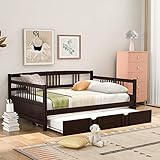
2. AFI Cambridge Wood Daybed — Runner-up
The 600 lb stated capacity and 1 year warranty make this the sturdiest single-surface frame here, if you can live without a second bed.

Best for: a kid's room doubling as a sitting room for guests Skip it if: you need a second sleeping surface
AFI's Cambridge and Nantucket share a spec sheet almost exactly, and the Cambridge is the one I'd take. It's 34.6 x 39 x 79.5 in and 107.4 lb, which is 53 lb heavier than its Nantucket sibling for the same claimed 600 lb capacity. That extra mass suggests more material in the frame, and it's the reason this one ranks above the Nantucket for me.
The design difference is a curved back board over the tongue and groove beadboard, versus the Nantucket's flat beadboard panel. In white, it reads more like a sofa than a bed, which matters in a room that hosts adults.
AFI describes the construction as a mixture of solid hard wood and wood veneer, and includes a slat kit rather than publishing a slat count. That's a gap next to Camaflexi's 14. The listing recommends a 6 to 8 in twin mattress, not included.
The honest loss here is obvious: no trundle, no drawers, nothing under the frame but floor. For a kid with a sibling or a regular sleepover crowd, that's a real limitation the Camaflexi solves outright.
Pros:
- Highest stated capacity in the set at 600 lb
- 1 year limited manufacturer warranty
- 107.4 lb frame, twice the mass of the Nantucket
- Curved beadboard back reads as a sofa in a shared room
- Narrowest twin footprint here at 39 in
Cons:
- No trundle and no drawers, so zero extra sleeping or storage space
- Solid hard wood mixed with veneer rather than solid throughout
- Slat kit included but no slat count published
- Mattress height limited to a recommended 6 to 8 in
- Heavier than the Nantucket for identical claimed capacity
3. TOLEAD Daybed with Trundle — Best budget pick
The cheapest of the six and the only one that names its timber, but its stated capacities are the lowest published here.

Best for: siblings sharing a small room on a tight budget Skip it if: a bigger kid or an adult will sleep on it
TOLEAD is the only pick here that names the actual species. The listing describes high-quality natural pine wood, moisture resistant and sturdy, and no other product in this set gets more specific than "solid hard wood" or "solid and manufactured wood". For a solid wood daybed for kids where the material claim matters to you, that specificity counts.
It's also the second-lightest frame at 70.4 lb, and it sells faster than any other pick here. Assembled it's 35.4 x 79.5 x 82.3 in overall, with the upper bed at 75.5 x 41.8 in and the trundle at 75.5 x 40.5 in. TOLEAD says the frame converts from a single bed to two separate ones, which is useful if the kids eventually want their own corners.
Now the number that decides it. TOLEAD publishes 200 lb on the upper bed and 175 lb on the trundle. Camaflexi claims 450 lb and 250 lb for the same twin-plus-twin arrangement. A 200 lb ceiling is fine for a seven-year-old and thin for a fifteen-year-old, and it's the trade-off you accept for the cheapest price position here.
Pros:
- Cheapest pick of the six
- Only listing that names its timber, natural pine
- Converts from one bed into two separate beds
- Second-lightest frame at 70.4 lb
- Full sub-dimensions published for bed and trundle
Cons:
- Lowest stated upper-bed capacity here at 200 lb
- Lowest stated trundle capacity here at 175 lb
- No published warranty
- Widest overall footprint of the twin picks at 82.3 in
- Two twin mattresses required, sold separately
4. KOMFOTT Wood Twin Bed Frame with Fence Rails — Best for beginners
The only pick with guard rails, drawers and a side shelf, which makes it the natural first bed after a crib.
Best for: a first bed after the crib, with toy storage underneath Skip it if: you need a second mattress for guests
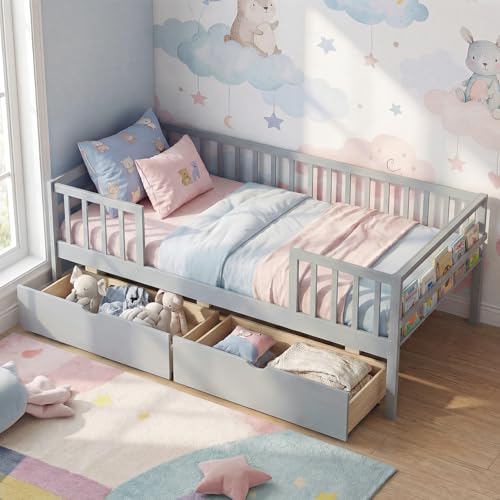
KOMFOTT takes the opposite approach to the trundle models. Instead of a second mattress, you get 2 large drawers underneath and a side shelf, plus solid wood guard rails on the open side. KOMFOTT says the rails offer a sense of security while encouraging a child's independence and mobility, which is marketing phrasing for the practical point: a three-year-old can climb in and out unassisted without a roll-out risk.
It's 28.5 x 80 x 41 in and 75 lb, making it the second-cheapest pick here and one of the more compact twins. The drawers are described as sized for bedding, toys or seasonal clothing, and KOMFOTT states a wooden slat support system with no box spring needed.
Two gaps to weigh. There's no published weight capacity anywhere in this listing, which is unusual in a set where four of six give you a figure. And there's no stated warranty, so you're relying on standard returns.
The trade-off against Camaflexi is straightforward. You gain drawers, rails and a shelf, and you lose the guest bed. For a first bed that's usually the right swap.
Pros:
- Only pick here with solid wood guard rails
- 2 large drawers plus a side shelf
- Second-cheapest of the six
- Compact 41 in width for a small room
- Slat support system, no box spring needed
Cons:
- No published weight capacity anywhere in the listing
- No stated warranty
- No trundle, so no second sleeping surface
- No slat count given, only a slat system claim
- Grey is the only finish listed
5. AFI Nantucket Wood Daybed — Best for pros
Same 600 lb claim and 1 year warranty as the Cambridge in a walnut finish, at less than half the frame weight.

Best for: a room where the daybed has to look like real furniture Skip it if: you want storage or a trundle included
The Nantucket is the design pick. Traditional tongue and groove beadboard in walnut, 34.6 x 40 x 78.8 in, and AFI positions it as usable as a bed, sofa or couch. In a room that has to work for a kid now and a teenager later, the finish is what buys it a long life.
It carries the same 600 lb claim and the same 1 year limited warranty as the Cambridge, from the same solid hard wood and veneer mix. The difference is mass: 54 lb against the Cambridge's 107.4 lb. That's the lightest frame in this entire group by 16 lb, which makes it much easier to carry up a staircase and assemble alone.
But 54 lb supporting a claimed 600 lb is a bigger ask than 107.4 lb supporting the same figure, and with no slat count published I can't tell you where the extra strength lives. If two identical claims come from frames of very different weights, I'd rather have the heavier one under a kid who jumps.
Like the Cambridge, it wants a 6 to 8 in twin mattress, not included, and there's nothing underneath it.
Pros:
- 600 lb stated capacity, tied highest here
- 1 year limited manufacturer warranty
- Lightest frame in the set at 54 lb
- Walnut beadboard reads as adult furniture
- Slat kit included, no box spring needed
Cons:
- No trundle and no drawers
- Half the frame weight of the Cambridge for the same claim
- Second-most expensive pick here
- No published slat count
- Recommended mattress height capped at 8 in
6. Merax Full Size Daybed with Twin Trundle — Best for heavy use
The only full-size bed here, with a twin trundle underneath and three-sided rails, for the kid who has outgrown a twin.

Best for: an older kid who wants a full mattress plus a guest twin Skip it if: floor space is under about seven feet wide
Every other pick in this roundup is a twin. Merax is a full, with an upper bed measuring 76 x 54.5 in and a twin trundle beneath, released in 2025. For an eleven-year-old who wants room to sprawl or a teenager who'll keep the bed through high school, a full changes the whole equation.
The frame is 35.4 x 78.2 x 57.5 in and 90.4 lb, in espresso, with three-sided rails that Merax says let it work as a sofa or seat as well as a bed. Those rails are a genuine advantage over the AFI pair for a younger kid on the top surface.
The catch is space. At 57.5 in wide plus clearance to pull the trundle, this wants a wall most kids' rooms don't have. It's also the slowest seller of the six by a wide margin, and only one seller lists it.
The data gaps are the real weakness. No stated weight capacity, no warranty, no slat count, and no published trundle dimensions. Next to Camaflexi's 450 lb and 14 slats, that's a lot of unknowns for a mid-range price position.
Pros:
- Only full-size upper bed in the set, 76 x 54.5 in
- Twin trundle included underneath
- Three-sided rails for younger sleepers
- 2025 release, the newest listing here
- Doubles as a sofa or seat per the listing
Cons:
- No published weight capacity for bed or trundle
- No stated warranty
- 57.5 in wide, the largest footprint here
- Slowest-selling pick of the six
- No slat count or trundle dimensions given
Will it fit the room you have?
Measure before you shop. Here's the order I'd do it in.
- Measure the wall. Widths here run from 39 in (AFI Cambridge) to 82.3 in overall (TOLEAD) and 57.5 in (Merax full). That's not a small spread.
- Measure the pull-out clearance. A trundle needs roughly its own width in front of the bed to open. Camaflexi's trundle is a twin, so budget about 40 in of clear floor.
- Measure the drawer swing. KOMFOTT's 2 drawers pull from one side, so that side needs clearance too.
- Check the doorway and stair turn. The heaviest twin here is 114.5 lb (Camaflexi) and the lightest is 54 lb (AFI Nantucket).
- Check your floor. Low-pile carpet or hard floor for any trundle. Camaflexi's listing flags thick carpeting specifically.
- Check ceiling and window height. The tallest headboard here is TOLEAD at 35.4 in.
The overlooked one is number two. A trundle that can't open isn't a trundle, it's a dust drawer.
Do these count as a solid wood daybed for kids?
Worth being straight about this, because the phrase gets stretched.
Only TOLEAD names an actual species: natural pine throughout. Both AFI beds are described as a mixture of solid hard wood and wood veneer. Camaflexi says solid and manufactured wood. KOMFOTT mentions solid wood guard rails and wooden slats. Merax says solid wood in the title.
So "solid wood" in this category almost always means solid wood in the load-bearing parts with engineered panels or veneer on the flat surfaces. That isn't a scandal, it's how furniture at this price is built, and a veneered headboard on a solid frame is stronger than solid pine that's warped.
On the kids angle: none of these are certified or rated for children specifically. Four of the six listings mention kids or teens in their copy, and KOMFOTT and Merax add rails, but that's positioning rather than a safety standard. Judge each one on the numbers you can see: stated capacity, slat support, rail presence, mattress height limits. A frame claiming 600 lb with a slat kit is a reasonable bet for a child. A frame with no published capacity is one you're taking on trust.
What the listings do not tell you
Four things you'll only find out after delivery.
Assembly time. TOLEAD and Merax both say assembly is quick and easy with all hardware included. Camaflexi's title says easy assembly. None of them give a time or a person count. A 114.5 lb frame is a two-person job regardless of what the instructions say.
Trundle mattress height. AFI publishes a 6 to 8 in recommendation for its twins. No trundle listing here tells you the maximum mattress thickness that still lets the trundle slide under. Measure the trundle clearance yourself and buy thin.
Noise. Wooden slat beds squeak when joints loosen, and a kid's bed loosens faster than an adult's. Nothing in any of these listings addresses hardware retightening.
Finish durability. Castanho, walnut, white, grey, natural, espresso. Six finishes, zero information about scratch or scuff resistance on any of them. White shows marks fastest in my experience of light finishes on kids' furniture.
The verdict
The Camaflexi Mid-Century Modern Daybed & Trundle is the best solid wood daybed for kids for most families, and the reason is documented support. Fourteen slats on the daybed, twelve on the trundle, 450 lb stated up top and 250 lb below. No other pick here publishes that much detail about what holds the mattress, and that trundle capacity is 75 lb higher than the next best.
Two conditions flip it.
If nobody sleeps over, take the AFI Cambridge. You give up the second mattress and gain a 600 lb claim, a 1 year warranty instead of 6 months, and the narrowest twin footprint here at 39 in. In white with a curved beadboard back, it also passes as a sofa, which the Camaflexi does not.
If the kid is eleven or older, take the Merax. A full-size upper bed at 76 x 54.5 in plus a twin trundle is a bed that lasts into high school. You'll need 57.5 in of wall plus pull-out clearance, and you'll accept no published capacity figure and no warranty in exchange.
The budget answer is TOLEAD, and it's a real answer for a young child. Just know that 200 lb upper-bed and 175 lb trundle ceilings are the lowest here, and a growing kid closes that gap faster than you'd like.
FAQ
Is a solid wood daybed for kids worth it over a metal frame?
A solid wood daybed for kids is worth it mainly for capacity and quiet. The frames here publish figures from 200 lb up to 600 lb, and wood joints handle a jumping child with less rattle than tubular metal. The catch is weight: the Camaflexi runs 114.5 lb assembled, so moving day is harder than with metal.
Which offers better value, the Camaflexi or the TOLEAD?
Better value between the Camaflexi and the TOLEAD depends on the sleeper. TOLEAD is the cheapest of the six and names its pine, but publishes only 200 lb on the upper bed. Camaflexi is the most expensive here and publishes 450 lb, plus 14 slats and 12 in the trundle. For a child under eight, TOLEAD stretches further. For a teen, Camaflexi.
What mattress height fits these daybeds?
Mattress height for these daybeds is stated only by AFI, which recommends 6 to 8 in on both the Nantucket and Cambridge. Go thicker on a framed daybed and the mattress rises above the side rails, which cancels the containment they provide. For the trundle models, measure the under-bed clearance before buying, since none publish a maximum trundle mattress thickness.
Do any of these include a mattress or need a box spring?
None of these include a mattress, and none need a box spring. All six use slat support instead. Camaflexi publishes 14 slats on the bed and 12 on the trundle, AFI supplies a slat kit, and KOMFOTT and Merax describe wooden slat systems. Twin-plus-twin models like the Camaflexi and TOLEAD need two twin mattresses bought separately.
What is the biggest mistake when buying a daybed with a trundle?
The biggest mistake buying a trundle daybed is forgetting the floor in front of it. A twin trundle needs roughly 40 in of clear space to pull out, and thick carpet fights the casters. Camaflexi's own listing flags that. Measure the open floor, not just the wall, and check your carpet pile before you commit.
Start with the tape measure, not the product page. Note your wall width, your clear floor in front of the bed, your stair turn and your carpet pile, then match those four numbers against the dimensions in the table above. That single step eliminates two or three of these picks before finish or price enters the conversation.
Then default to the Camaflexi. Not because it's the prettiest here, but because it's the one that tells you the most about what's under the mattress: 14 slats, 450 lb up top, 250 lb below. In a bed a child will bounce on for a decade, published support beats a nice headboard.