Best Professional Olive Oil for Serious Home Cooks

Seven olive oils sorted by bottle size, origin, and polyphenol claims, with clear picks for finishing, sautéing, and everyday volume cooking.

By Colette SalinasUpdated 18 min read
On this page
- Best professional olive oil at a glance
- Who this guide is not for
- How I screened the field
- 1. Atlas Organic Extra Virgin Olive Oil, 1 L — Best overall
- 2. Atlas Organic Extra Virgin Olive Oil, 3 L Tin — Best premium
- 3. OLIVEA Ultra High Phenolic Olive Oil — Best for pros
- 4. Desert Miracle Organic Extra Virgin Olive Oil — Runner-up
- 5. Pompeian Smooth Extra Virgin Olive Oil — Best minimal setup
- 6. Graza Sizzle Extra Virgin Olive Oil — Best budget pick
- 7. Amazon Grocery Extra Virgin Olive Oil — Best for beginners
- Finishing oil or cooking oil? The split that decides it
- What the polyphenol numbers actually mean
- Bottle size, tin, or squeeze: which format wins?
- What the listings do not tell you
- The verdict
- FAQ
The best professional olive oil for a serious home cook is Atlas Organic Extra Virgin Olive Oil in the 34 fl oz bottle: a single-origin Moroccan oil with a stated high-polyphenol profile that reads like a finishing oil you can also cook with. If you already move through olive oil quickly, the 3 L Atlas tin costs less per ounce and stays fresher than any bottle refilled every week. Neither pick is cheap, and that is the trade you are making.
Best professional olive oil at a glance
| Pick | Size | Origin | Price |
|---|---|---|---|
Best overall Atlas Organic Extra Virgin Olive Oil, 1 L |
34 fl oz bottle | Morocco | Check Price |
Best premium Atlas Organic Extra Virgin Olive Oil, 3 L Tin |
101 fl oz tin | Morocco | Check Price |
Best for pros OLIVEA Ultra High Phenolic Olive Oil |
16.9 fl oz bottle | Greece (Olympia) | Check Price |
| 17 fl oz bottle | Morocco | Check Price | |
Best minimal setup Pompeian Smooth Extra Virgin Olive Oil |
68 fl oz bottle | Imported blend | Check Price |
Best budget pick Graza Sizzle Extra Virgin Olive Oil |
750 mL squeeze | Spain, single origin | Check Price |
Best for beginners Amazon Grocery Extra Virgin Olive Oil |
51 fl oz bottle | Not stated | Check Price |




Who this guide is not for
A word on the "professional" label before we go further. Every oil here is sold at retail on Amazon, in packaging a home kitchen can store. None of them ship in the 5-gallon jugs a restaurant line cook would recognize, and none of the listings claim food-service certification you could hand to a health inspector. If you are stocking a working kitchen, this is not the guide.
What "professional" actually signals in this set is a step up from generic supermarket blends: single-origin sourcing, stated cold pressing, published polyphenol claims, and larger formats than the 500 mL bottles most groceries stock. The best professional olive oil for a home cook, in that sense, is the one that behaves like the bottle a restaurant would keep near the pass: fresh, traceable, and used quickly enough to matter.
Three types of buyer should stop here and pick something else. Fry cooks working with liters per week need bulk food-service supply, not retail bottles. Anyone shopping strictly on lowest cost per ounce is better served by a warehouse-club private label. And if you only cook with olive oil twice a month, a 3 L tin will go rancid before you finish it.
How I screened the field
I started with the seven listings in this set and compared what each one actually publishes, because the marketing on an olive oil bottle is usually louder than the specifications. My screen was simple.
- Extra virgin only. Every pick here is labeled extra virgin, which is the grade a serious cook wants for both finishing and most cooking.
- Traceable origin. Six of the seven name a country. One does not, and that matters for how I ranked it.
- A published claim about polyphenols or cold pressing. Five of the seven make one or the other explicit in their listing.
- A format a home kitchen can store. Bottles from 500 mL to 2 L and one 3 L tin all qualify. Nothing bigger.
That gave me the seven picks in the table. From there, I split them by job: finishing oils where flavor and polyphenol claims matter, cooking oils where a mellow profile and volume matter, and one large-format pantry option where the calculation is different again.
What did not decide it: the bottle color, the brand's marketing story, or the age of the listing. Two of these products released in 2021 and 2018 and are still on shelves for a reason. One released in 2025 and is essentially the same oil as the 1 L version scaled up.
1. Atlas Organic Extra Virgin Olive Oil, 1 L — Best overall
A single-origin Moroccan oil with a stated high-polyphenol profile in a size a home cook will finish while it is still fresh.
Best for: cooks who want one high-polyphenol Moroccan oil for finishing and light cooking Skip it if: you burn through more than a liter a month
Atlas wins this set on the balance between quality signals and format. The listing states 34 fl oz, single-origin from the Atlas Mountains region, cold-pressed, USDA organic, and high polyphenol. That is more traceability than five of the six other picks publish. The bottle sits at 0.5 x 4.72 x 2.36 in, which is a slim rectangular profile that fits pantry doors and cabinet racks other 1 L bottles jam against.
The brand says the flavor takes in almonds, culinary herbs, and notes of banana, lemon, and basil, and calls it a single-pressing organic oil. Attributed claims, not measured ones, but the sourcing story is at least specific enough to check.
What it gives up is quantity. At 34 fl oz you pay premium band pricing for a bottle you can finish in a month of drizzling. A cook who wants one oil for a whole quarter of cooking should size up to the 3 L tin below, from the same brand.
Pros:
- Single-origin Moroccan sourcing
- Stated cold-pressed, single-pressing process
- USDA organic label
- Slim bottle profile fits tight cabinets
- High-polyphenol claim on the listing
Cons:
- Premium price position for the volume
- Only 34 fl oz per bottle
- Polyphenol number is not published as a figure
2. Atlas Organic Extra Virgin Olive Oil, 3 L Tin — Best premium
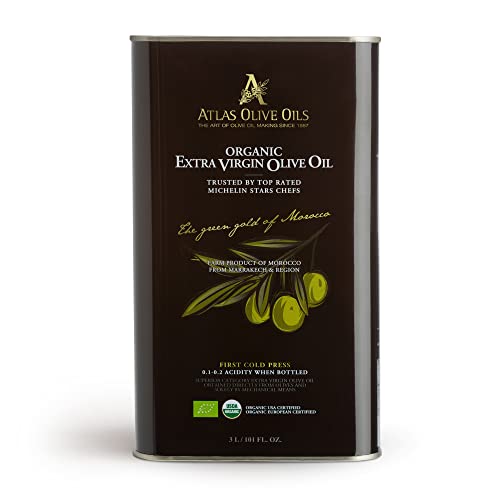
The same Moroccan oil as the winner, in a 101 fl oz tin, for households that will actually finish it.
Best for: households or small kitchens working through olive oil weekly Skip it if: you cannot store a 3 L tin cool and dark
Three liters is 101 fl oz, or roughly three times the 34 fl oz winner. The tin is the classic olive oil format for a reason: metal blocks light better than most bottles, and light is what kills polyphenol content over the shelf life. The listing repeats the Moroccan Atlas Mountains sourcing, the cold-pressed claim, and the USDA organic label, so on paper this is the winner's oil in a larger container.
It is the most expensive pick here in absolute terms, and it is the slowest seller of the seven, which is what you would expect from a large-format premium tin. Neither of those matters if you cook every day. The trade is upfront outlay against price per ounce, and against the risk you overestimate how much olive oil your kitchen uses.
Once opened, a 3 L tin needs a smaller decanting bottle beside the stove and a cool, dark spot for the tin itself. Treat it like the pantry investment it is and it earns its position. Treat it like a supermarket bottle you leave beside the range and the polyphenols degrade faster than you think.
Pros:
- 101 fl oz in a light-blocking tin
- Same Moroccan single-origin sourcing as the winner
- USDA organic and cold-pressed claims
- Lower price per ounce than the 1 L bottle
- Suits weekly-use households
Cons:
- Highest total outlay in the set
- Needs decanting for daily use
- The slowest seller of the seven
- No published polyphenol figure
3. OLIVEA Ultra High Phenolic Olive Oil — Best for pros
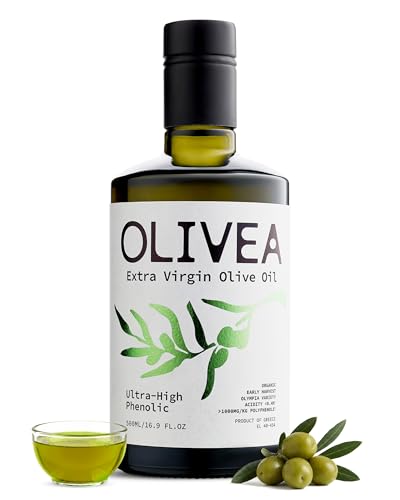
The only pick here that publishes a polyphenol figure, and it uses it to argue for daily-shot use rather than sauté.
Best for: buyers focused on measured polyphenol content for daily use Skip it if: you want a workhorse for sauté volume
OLIVEA is the only oil in this set that puts a number on the polyphenol claim rather than the word "high." The listing states 1000+ mg/kg total polyphenols, verified by NMR according to the brand, from early-harvest Greek Koroneiki olives grown in Olympia and cold-extracted within hours. The brand also positions a 20 g serving as a "phenolic shot," which tells you where they see the oil sitting in a kitchen: closer to a supplement bottle than a cooking bottle.
At 16.9 fl oz it is the smallest bottle here, and the second-most-expensive pick in the set. That combination is what "for pros" means in this listing's world: someone who has decided polyphenol content is the deciding specification and is buying accordingly. If that is not you, you are paying for a spec you do not need.
For actual cooking, the brand suggests drizzling over finished dishes or salads, and the peppery profile Koroneiki oils are known for should stand up on cooked vegetables. It is not the bottle you use for a sheet pan of potatoes.
Pros:
- Published polyphenol figure of 1000+ mg/kg
- Single-origin Greek Koroneiki olives
- USDA Organic, EU Organic, and Non-GMO labels
- Early-harvest, cold-extracted sourcing story
- Compact bottle for a finishing role
Cons:
- Smallest bottle in the set at 16.9 fl oz
- Premium price for the volume
- Too costly for high-heat cooking
- Slowest seller after the 3 L tin
4. Desert Miracle Organic Extra Virgin Olive Oil — Runner-up
A second Moroccan high-polyphenol oil in a 17 fl oz bottle, close to Atlas in story and a step down in bottle size.

Best for: shoppers who want a Moroccan high-polyphenol oil in a smaller bottle Skip it if: you need a bottle over 17 fl oz
Desert Miracle sits close to Atlas in origin and process. The listing describes a Moroccan organic extra virgin olive oil, first cold-pressed, from trees grown in the country's rocky desert region roughly 150 kilometers from Casablanca. Bottle size is 17 fl oz at 1.06 lb, and the tall 13 x 2.5 x 2.5 in profile is the classic slim olive oil silhouette.
Why runner-up rather than winner: less detail on the listing, fewer feature bullets, and a smaller bottle than the Atlas 1 L at a mid-tier price position. The story is similar, the format is smaller. On the plus side, it is the second-cheapest Moroccan oil here after nothing directly comparable, so if you specifically want the Moroccan profile and do not want to commit to a full liter, this is the natural pick.
Against the OLIVEA above, Desert Miracle does not publish a polyphenol number, so anyone shopping on measured specifications will not choose it. Against Atlas, it loses on volume for a similar price band. Its case is that a slimmer, shorter-commitment Moroccan bottle is the right entry into the region's oils.
Pros:
- Moroccan single-origin sourcing
- First cold-pressed and organic labels
- High-polyphenol claim on the listing
- Mid-tier price rather than premium
- Slim, tall bottle format
Cons:
- Only 17 fl oz per bottle
- Fewer published details than Atlas
- No polyphenol figure given
5. Pompeian Smooth Extra Virgin Olive Oil — Best minimal setup
A 68 fl oz bottle in the entry price band from a brand certified for authenticity by the North American Olive Oil Association.

Best for: one bottle that covers sauté, roast, and dressing without swapping Skip it if: you want a bold, peppery finishing oil
Pompeian is what most kitchens actually need on the counter. The listing calls it a smooth, delicate extra virgin olive oil intended for sautéing, stir-frying, salads, and roasting vegetables. The brand states 68 fl oz per bottle, first cold pressed, and certification by the North American Olive Oil Association for authenticity, which is one of the few third-party checks in this set. The bottle measures 10.8 x 4.42 x 4.31 in, so pantry-friendly rather than counter-friendly.
The trade is flavor character. A smooth, mellow profile is what makes this bottle so easy to cook with; it also means you will not taste much on a piece of grilled bread. That is why it wins minimal setup rather than overall. It is one bottle covering the jobs a busy kitchen throws at it, at an entry-tier price for the volume, without the flavor punch a finishing oil brings.
Sales-rank wise it sells faster than every premium pick here, which fits its role: a workhorse buyers repurchase. Kosher, Non-GMO Project verified, and gluten-free labels appear on the listing.
Pros:
- 68 fl oz for the entry price band
- NAOOA certification claim
- Smooth flavor works across cooking methods
- Non-GMO Project verified and kosher labels
- Sells fast in this set
Cons:
- Mellow flavor lacks finishing punch
- Not single-origin
- Large bottle needs pantry space
6. Graza Sizzle Extra Virgin Olive Oil — Best budget pick
A 750 mL squeeze bottle of single-origin Spanish EVOO built for everyday heat, at the cheapest position in this set.

Best for: everyday cooking heat in a squeeze bottle Skip it if: you want a large-format refill
Graza is the cheapest of the seven and the most opinionated. It is the only single-origin oil here in a squeeze bottle, an intentional format choice that changes how the oil gets used at the stove. The listing states 750 mL (25.3 fl oz), single origin from Spain, single varietal, cold-pressed from mid-season olives. Weight comes in at 1.63 lb, and the bottle stands 10.5 x 2.8 x 2.8 in.
Graza pitches Sizzle as a cooking oil, not a finishing oil. The brand calls the flavor mellow because the olives are pressed later in the harvest, which gives up peppery bite in return for a more neutral profile at heat. That makes it a legitimate everyday oil rather than a bottle you save for salads.
The squeeze bottle is the point. You can dose olive oil into a hot pan with one hand, without the glug-glug pour a wine bottle format forces. If you keep two oils in your kitchen, Sizzle is a strong number two next to a finishing bottle from Atlas or OLIVEA. On its own it will not carry a salad the way a peppery oil does.
Pros:
- Cheapest of the seven
- Single-origin Spanish sourcing
- Squeeze bottle format for stovetop use
- Cold-pressed cooking oil, not a blend
- Higher smoke point than early-harvest oils
Cons:
- Only 750 mL per bottle
- Mellow flavor for finishing use
- No polyphenol figure published
7. Amazon Grocery Extra Virgin Olive Oil — Best for beginners
A 51 fl oz bottle at the second-cheapest position, for cooks who want volume without a sourcing story.

Best for: salad, marinade, and general pantry duty at high volume Skip it if: you want single-origin traceability
Amazon Grocery is the pick for readers who want an honest large-format bottle without paying for a story. The listing states 51 fl oz, cold-extracted, Non-GMO Project verified, and recommends it for salads and marinades. Weight is 3 lb, dimensions 10.7 x 3.74 x 3.74 in. That is a big, blocky bottle that lives in a pantry and gets decanted.
What the listing does not say matters more than what it does. There is no country of origin printed on the listing, no single-varietal claim, and no polyphenol reference. That is why it wins the beginner slot rather than a higher rank: it is the sensible bottle to keep in a house where multiple cooks reach for olive oil without thinking, and it is the wrong bottle if you care where the olives came from.
The second-cheapest price position, combined with the largest bottle size after the Atlas tin, gives it the best volume-to-outlay math outside the specialist picks. Use it for volume cooking and dressings you build with vinegar and mustard, and keep a finishing bottle for the plate.
Pros:
- 51 fl oz in one bottle
- Second-cheapest price position
- Non-GMO Project verified label
- Cold-extracted claim on the listing
- Straightforward pantry format
Cons:
- No country of origin on the listing
- No polyphenol or single-varietal claim
- Fewer published specifications than any other pick
Finishing oil or cooking oil? The split that decides it
Most guides on the best professional olive oil compare bottles as if one oil should do every job. That is the wrong frame. A restaurant kitchen keeps at least two oils near the line: a workhorse for sauté and roast, and a finishing oil for the plate. Home cooks who buy one bottle end up either overpaying for polyphenols they cook off, or underspending on a bottle too mellow to taste on bread.
Here is how the split looks in this set.
- Finishing side: Atlas 1 L, Atlas 3 L tin, OLIVEA, and Desert Miracle. Cold-pressed, single-origin, and (in three of four cases) high-polyphenol claims. Peppery flavors that survive on a finished dish.
- Cooking side: Pompeian, Graza Sizzle, and Amazon Grocery. Mellow profiles, larger formats, and price bands the finishing oils cannot match on volume.
The cutoff between them is the smoke point and the flavor. Polyphenol-rich, early-harvest oils are punchy raw and lose that character over a hot pan, so cooking with them is a waste of what you paid for. Late-harvest and blended oils are milder raw and hold up fine under heat.
If you buy one bottle from each side, you cover both jobs. If you buy one bottle only, ask which job you do more of.
What the polyphenol numbers actually mean
Polyphenols are compounds naturally present in olive oil that contribute to peppery flavor and are associated with antioxidant activity. Extra virgin olive oil is where most polyphenols end up, because refined oils lose them during processing. Six of the seven picks here claim to be high-polyphenol or first cold-pressed. Only one publishes a number.
That matters because "high polyphenol" is not a regulated term on olive oil packaging in the United States. A brand can print it based on the varietal and harvest timing without submitting a lab result. OLIVEA states 1000+ mg/kg total polyphenols, and says the figure was verified by NMR testing. Atlas, Desert Miracle, and Graza describe processes that typically produce high-polyphenol oils, without stating a figure.
Two practical rules follow. First, if polyphenol content is your priority, buy the oil that publishes the number, not the one that publishes the adjective. Second, polyphenols degrade with heat, light, and time, so a 500 mL bottle you finish in six weeks preserves more than a 3 L tin sitting open for six months, regardless of what either one started with. Format is a spec.
Bottle size, tin, or squeeze: which format wins?
Format is where these seven picks separate clearly, and it is a spec worth thinking about before flavor.
- The 34 fl oz slim bottle (Atlas) fits pantry doors and stays fresh through normal home use.
- The 3 L tin (Atlas premium) blocks light and lowers cost per ounce, but needs decanting and a real cook to use it.
- The 17 fl oz slim bottle (Desert Miracle) suits short commitment.
- The 16.9 fl oz short bottle (OLIVEA) reads like a finishing-only or shot format.
- The 68 fl oz bottle (Pompeian) is a countertop pour bottle for daily use.
- The 750 mL squeeze bottle (Graza) is chef-friendly for stovetop dosing.
- The 51 fl oz jug format (Amazon Grocery) is a pantry backup.
Pair the format to the job. A finishing oil in a large bottle is a bad idea because you cannot finish it fast enough. A cooking oil in a 500 mL bottle costs you refills every three weeks. A tin is only cheap if you finish it.
What the listings do not tell you
Every olive oil listing on Amazon carries a marketing story. What none of these seven publish is the harvest date, and that is the specification a serious buyer would want first. Olive oil is a fresh product, not a shelf-stable one. A bottle 18 months from harvest is a different oil from the same bottle at four months, even if the label is identical.
None of the listings state a bottled-on date or a harvest year, either. OLIVEA references "2025 early harvest" in the title, which is the closest any pick comes to committing. Atlas and Desert Miracle name their process but not their vintage.
Two practical moves for the reader. First, when the bottle arrives, look for a best-by date on the label and count backwards: the industry rule of thumb is roughly two years from bottling to best-by. Second, once opened, treat any bottle like a fresh product. Store cool, keep the cap on, and finish it inside three months of opening if you can. That does more for the taste of what you paid for than any argument between brands.
The verdict
The best professional olive oil in this set is Atlas Organic Extra Virgin Olive Oil, 1 L. It gives a home cook the sourcing story, the cold-pressed and organic labels, and the high-polyphenol positioning of the finishing-oil tier, in a 34 fl oz bottle a normal kitchen will finish while the oil is still fresh. Nothing else here combines those three things in the same format.
Two conditions flip the pick. If your kitchen moves through olive oil weekly and you have somewhere cool and dark to keep a large container, the Atlas 3 L tin is the same oil at a better rate per ounce. If polyphenol content is the specification you actually care about, and you want the number rather than the adjective, OLIVEA is the only pick here that publishes a figure. That is a shopping decision, not a cooking decision, and it should be made deliberately.
Everyone else should think in pairs. Keep a finishing bottle from the Atlas or Desert Miracle side of the shelf, and a cooking bottle from the Pompeian, Graza, or Amazon Grocery side. That is how a serious kitchen actually runs, and it costs less over a year than trying to make one premium bottle do both jobs badly.
FAQ
Is professional olive oil worth it over supermarket brands?
Professional olive oil is worth it if you use it as a finishing oil where you can actually taste it. A high-polyphenol, single-origin bottle like Atlas Organic 1 L brings peppery flavor to raw or lightly cooked dishes that a generic supermarket blend cannot match. For sautéing at high heat, that flavor cooks off, and a mid-tier bottle like Pompeian's 68 fl oz does the job.
What makes the best professional olive oil different from cooking oil?
The best professional olive oil differs from everyday cooking oil on three fronts: single-origin sourcing, cold pressing, and polyphenol content. All seven picks here are extra virgin, but only Atlas, OLIVEA, and Desert Miracle publish both origin and cold-pressed claims. Generic cooking oils skip origin entirely. That traceability is what "professional" tends to signal on a retail bottle.
Which is better for daily cooking, Graza Sizzle or Pompeian Smooth?
For daily cooking, Graza Sizzle is better if you want single-origin Spanish oil in a squeeze bottle at 750 mL, and Pompeian Smooth is better if you want more oil per bottle at 68 fl oz and a NAOOA authenticity claim. Graza costs less; Pompeian gives you more volume per purchase. The choice is format and story, not cooking performance.
How long does olive oil last after opening?
Olive oil lasts roughly three months after opening before flavor and polyphenol content start to drop noticeably, especially in a clear bottle stored near heat. The 3 L Atlas tin lasts longer because metal blocks light, but only if you keep the cap sealed between uses. Buy the format you will actually finish in that window rather than the one with the lowest per-ounce math.
Do polyphenol numbers on olive oil bottles mean anything?
Polyphenol numbers mean something when the brand publishes a specific figure and states how it was measured. OLIVEA lists 1000+ mg/kg total polyphenols and says the figure was verified by NMR. The phrase "high polyphenol" without a number is a marketing claim, not a measurement. If polyphenol content is why you are shopping, buy the bottle that publishes the figure.
Start with one bottle from the finishing side and one from the cooking side, and you have covered the two jobs a serious home kitchen actually needs an olive oil to do. Atlas Organic 1 L is the default finishing bottle because the sourcing, the process, and the format all line up for a real home cook rather than a food-service buyer. Pair it with Pompeian, Graza, or Amazon Grocery for the pan, decant the tin if you go premium, and pay attention to how quickly you finish what you open. That is the difference the best professional olive oil actually makes on a plate.